


Taiwan
Summer 2025
May 2025- July 2025
Through Clemson University, I had the opportunity to study abroad at Chung Yuan Christian University in Taoyuan, Taiwan. Located just outside the capital city of Taipei, the university offered my classmates and me the chance to travel frequently and explore on weekends. The summer program was divided into two sessions. In the first session, my mornings began with individual tutoring, followed by a language lecture taught by a Taiwanese professor from Chung Yuan Christian University. In the afternoons, I attended a Chinese business communication course led by one of my professors from Clemson University. During the second session, I spent the first half of each day working for Shuang-Lian Pears Corporation (see Internship tab) in the university’s business building. In the afternoons, I took a cultural studies course with another Clemson professor and continued meeting with my tutor once or twice a week.


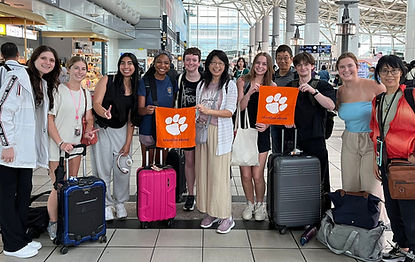
Outside of class, I explored various cities across Taiwan, including Taipei, New Taipei, Kaohsiung, Kenting, Tainan, Taichung, Longtan, and Miaoli, my favorite trip being to Jiufen. I engaged in a range of cultural activities such as releasing lanterns, visiting temples (notably Fo Guang Shan), attending the Dragon Boat Festival, hiking, exploring museums, taking a boat ride on Sun Moon Lake, and even cliff jumping in Jiufen. I also enjoyed sampling diverse regional cuisines, visiting both modern and traditional medical offices, and experiencing Taiwan’s vibrant markets and street culture. On campus, I attended concerts, visited club pop-up stands, and participated in an English camp where students creatively turned language learning into a Monopoly-themed activity. Additionally, I had the opportunity to engage with students from Chung Yuan Christian University, visit a local high school (DYSH) for cultural exchange discussions, and teach at a middle school (DLJH), where I introduced aspects of American culture, including landmarks, holidays, and traditions.
Prior to my arrival in Taiwan, I constantly struggled with the fear that I would face many obstacles since my Mandarin is not as advanced as it perhaps should be. However, this has not been the case at all. Aside from the occasional awkward transaction of looks and shuffling for the phone after not understanding one another in conversation, my interactions with fellow Taiwanese people have been quite nice. These brief moments of miscommunication have become learning opportunities rather than major setbacks. When conversing in Mandarin, Taiwanese people will often speak a little slower and utilize simpler diction, which I appreciate. To my surprise, the majority of the Taiwanese people I have encountered have some knowledge of English, making communication even more accessible! This writing is a reflection of my experience in Taiwan over the last month, contrasting American and Taiwanese culture. I have highlighted several key topics through my observations, including people, transportation, and food.
Undoubtedly, the most defining characteristic of Taiwanese culture is its quietness. Most Taiwanese people are pretty shy, and some will choose to wear a face mask in public for this very reason. Additionally, in contrast with the average American, Taiwanese people typically speak at a low volume. This is evident in public spaces such as elevators and trains, where there is little to no noise. In restaurants, interactions are minimized through their ordering system. Upon entering the establishment, there are menus for customers to mark their desired dishes, hand their menu and money to the cashier, and receive a receipt. This process is often streamlined through the platform Line, allowing customers to scan a QR code to order and pay online. Although this option is available in America, this is not the typical dining experience. Since servers’ wages in America are based solely on tips, interaction with customers is highly encouraged. Refilling drinks, suggesting menu items, bringing napkins, silverware, and condiments are some of the responsibilities of American servers. In contrast, Taiwanese restaurants will have stations readily available for customers to help themselves to. This self-service approach reflects both the efficiency and the independence commonly found in Taiwanese daily life.
During sessions called “cultural exchange,” opportunities where Americans are paired with Taiwanese students, Taiwanese students have shared their perception of Americans as “highly energetic” and “outgoing.” I fit into this narrative, consistently feeling drained in my conversations with them, as I often feel like I dominate the conversation. These moments have made me more conscious of how differently communication is approached across cultures. I remember, once, my group showed me a presentation that explained how, when Americans openly disagree, it is not as a means to challenge, but rather to comfortably converse, which I believe to be true. This behavior is in contrast with the reserved energy of Taiwanese people. I have witnessed very few confrontations in Taiwan, even in situations where they may seem warranted, such as in traffic. I have seen numerous close-call accidents on the roads that Taiwanese drivers simply brush off. In truth, the amount of road rage I’ve seen in just a few days back in America far exceeds anything I’ve witnessed throughout my time in Taiwan.
On that note, Taiwan and American transportation are vastly different. Public transportation, such as trains, buses, and the MRTs, is the main means of long-distance travel in Taiwan. For short-distance travel, Taiwanese people use bikes and mopeds. The number of mopeds on the road is striking, sometimes even outnumbering the cars. In America, people drive their cars everywhere. Whether their destination is ten minutes or ten hours away, most Americans, including me, will choose to drive themselves out of convenience. At first, I missed the freedom of jumping into my own car, but I’ve come to enjoy the convenience of hopping on these various modes of public transportation. With possession of a travel card called a YoYo Ka, which also stores money, navigating the city becomes incredibly easy. You can use it to hop on buses, trains, and MRTs, or even make purchases at convenience stores like 7-Eleven. In contrast to America, driving a car here is often more of a hassle than it’s worth. Not only are there narrow streets, hectic traffic, and limited parking, but safety measures also seem loosely enforced. I get so stressed when I see a young child riding on a scooter! It can be a real challenge. Public transit is not only the smarter choice, but also the more relaxing one. Rides are peaceful, as passengers will scroll on their phones, read, or simply rest their eyes. I find Taiwan’s public transportation system to be significantly more efficient and reliable than that of the United States. It’s satisfying to know exactly when a train is arriving, thanks to the live tracking screens in every station. Public transportation is not only affordable and fast but also environmentally friendly. Unlike public transportation in the United States, those in Taiwan are kept tidy and are thoughtfully designed, containing hooks, shelves and compartments to place belongings. Altogether, Taiwan’s transportation system reflects a culture that values efficiency, accessibility, and shared public space, something I’ve come to deeply appreciate.
Lastly, food is the third and final category in my observation. Taiwan offers an abundance of authentic cuisine, which I absolutely love! I can easily walk to the night market nearby, watch my food being prepared right in front of me, and know it will be both quick and delicious. Even convenience stores like 7-Eleven serve freshly made meals, making it easy to eat on the go without sacrificing taste or quality. Not only is the food convenient and flavorful, but it’s also significantly cheaper than in the United States. Portion sizes in Taiwan are generally smaller, yet meals still feel balanced and satisfying without being overwhelming. Many dishes are centered around animal meat, and I’ve noticed the food tends to be a bit more oily overall. One major difference I’ve observed is how menus are presented. In the U.S., dishes often come with allergy warnings or list ingredients like gluten, peanuts, or dairy. In Taiwan, menus usually don’t include detailed ingredient lists, which can be surprising at first. Another notable contrast is in restaurant ownership. Most establishments in Taiwan are locally owned, giving meals a more personal, homemade feel, unlike in America, where chain restaurants are much more common. There are also several cultural differences in dining etiquette. For example, while Americans typically eat with forks and knives, Taiwanese people primarily use chopsticks and spoons. It’s perfectly normal in Taiwan to raise your bowl while eating, but in the U.S., that might be considered rude. Meals are shared in Taiwan, but individually in the U.S. Beverage customs also differ: tea is the default drink served at nicer restaurants in Taiwan, while in America, it’s usually ice-cold water. Because many dishes in Taiwan include bone-in meat or seafood, it’s common to see people politely spit out bones at the table. In contrast, Americans tend to remove fat and bones before the food reaches the table. Another interesting aspect is that many Taiwanese restaurants provide designated stations for returning trays, sorting utensils, and disposing of food waste properly. Add-ons like egg or cheese are often recommended here, similar to how we might “load” a baked potato in the United States. And of course, rice is incorporated into almost every meal, and hot water is often served instead of cold. When the time comes for me to return to America, I know I’ll wholeheartedly miss my go-to pork and rice dish from the restaurant near campus.
My experience in Taiwan has been overwhelmingly positive, ranging from the people to the transportation to the food, everything has far exceeded my expectations. I’ve learned more about Taiwanese culture, improved my Mandarin, and learned how to handle language barriers. It’s also taught me patience, humility, and how to find confidence in moments of discomfort. After living here, I could genuinely see myself returning to stay for a longer period in the future. I’m incredibly grateful for the opportunity to live and learn within this community, and I’m excited to see what the rest of my time here holds. I know that the lessons, memories, and relationships I’ve formed will stay with me long after I leave.